Wednesday, 27 November 2013

Idea for a Production team name


So after some umming and arring on what to call ourselves we finally agreed on a production team name! 
we have chosen as a group "Limelight".
The reason we chose the name is because we have based it on the actual phrase 'Limelight' to signify that the films produced through "Limelight productions" are always in the spotlight or rather limelight. This sets a certain standard within the group to produce a film worthy of being described as being in the limelight since it has to have left a lasting impression on the audience. 

Have a look for yourself at our free hand sketch, We hope to recreate this image in a more professional manor later on: 


Initial idea for our thriller film

After initial discussion between the group we have come up with our first narrative draft. Our draft follows as...

The film opens to see a person rushing to unlock a door with a key drawn from their pocket. They unlock the door and half close it behind them leaving it slightly ajar. They rush through the hall way into the kitchen and hurriedly wash their hands there's sounds of heavy breathing coming from our anonymous person and the sound of their heart played over the film. They take a bag from the side and fill it with items preplaced on the side. The shot switches to feet walking up a drive, the camera moving to the back of the strangers head as they reach the door. The person looks left and right but not showing their face to the camera and push the ajar door open with deliberate carefulness. They walk in to find no sign of the first person. shot changes to their clenching fist. They take out their phone, speed dial a number and speak into it.

"They're not here."
...


The shot switches back to the first person who is now running, glancing all around as they run. Change shot to second person, taking purposeful strides sounds of their posh shoe's clacking on the pavement, change shot back to the first man running, his breathing is fast and in scared gasps, tense music starts to play to raise the tension, quick shot of seconds mans feet picking up speed, Back to the first man just as he runs around the corner and comes face to face with the second person and the first person steps back in shock with a panicked sound, eyes wide and pale.

PRO'S

  • No complex shots identified, so it should appear professional
  • Local locations and self provided costumes meaning we won't have to spend money, 
  • props are also are on hand and do not need to be brought 
  • only need 2 actors
  • set in the present pretty much so there shall be no worries of time period mistakes 
CON'S
  • Finding actors that look the part and CAN ACT - if you have rubbish acting in a film you will find it downgrades the whole quality of it. 

Thursday, 14 November 2013

Choosing a genre to work with!

I shall be discussing why I choose the genre I did with Pro's and Con's weighed out and our class evaluation of other genres, this will show you how we came to decide on our genre for our media product.

The genre we choose was "Thriller" Why ? Well i'll show you.

Pro's of a Thriller film 
  • Doesn't require a multi million pound budget for special effects, costumes, settings etc 
  • The conventions of a thriller are so obvious that a student like myself could recreate them
  • Basic lighting techniques can be used to set the thriller atmosphere like low lights or different colored lights
  • Sound effects are simple and can be found online or even recreated (this is known as foley sounds)
  • The plot of a thriller is flexible as long as it has the peak of tension points
Con's of a Thriller film
Well there are not many definite thriller con's, only that if you have a complicated intense plot that needs a lot of atmospherics and effects this could impose a need for a lot more money and software to create your movie. BUT as we are not looking to create a whole movie with an intense plot and a lot of effects and atmospherics this is not a con for us to consider. 

Here is our class research into choosing a genre, as you will see Thriller is the best for us at AS Level right now; 


22 Stories

Here's an illustration that explains that apparently there's only 22 stories out there, these posted below are the 22 story plot lines, its worth considering these before writing our own film pitch as it may inspire us to be more creative with our pitches or maybe adhere to the stereotyped/cliched story line.
Underneath every story is an example movie to go with it, to support its claim too.


Wednesday, 13 November 2013

Advanced Camera Techniques

Camera Focusing

You can have a camera automatically focus of course, but with manual focusing you can control who or what the camera shall focus on, this is done by turning a dial usually placed around the fore front of the camera just before the lens, turning this dial changes the depth of field of your shot.
What is depth of field you ask?
Well Depth of field is how much your camera is in focus at the given time, if you have a clear shot where everything or mostly everything is in focus (the background and the foreground) you have a deep depth of field, If however you have a small amount focused in the shot you have a shallow depth of field.

The changing of this depth of field is done by this lens I mentioned earlier, to change the depth of field whilst filming is called a focus pull, as you are changing the viewers focus to something else. For example, You're filming a woman in a shallow depth of field walking towards the camera as we track her, we then do a focus pull to a deep depth of field to reveal there's a man 100 yards back with a mean look on his face following the woman.
The man was obscured before to the viewer as we had a Shallow depth of field which only shows things close to the camera but as we did a focus pull, he became visible as there was a deep depth of field which allows you to see things that are further away, in detail.

My media class's example: 


Crane Shot

A crane shot, sounds like what it actually is, it's a camera on a crane. Yes that's it really...
A crane shot allows you to enter or exit a scene via the sky coming in to the scene, or via the ground going up to the sky to come out of a scene.
It also allows you to film things from a "birds eye" perspective, and what ever other way you can think of filming that you may need to get your camera higher than steady reaching arm span.

Tip: When used in the right circumstances and setting, the crane shot technique, when its high looking down on a character can make them look to the audience as if their character is small and isolated.

After having a go on filming with the crane, I discovered that it's not a practical tool if you dont practice with it before filming, it has a slight weight to it, but mainly its hard to get a smooth appearance on screen, no jumpy footage and so forth.

here is our media classes very first attempt at filming with a crane shot:


And here is a professional movie crane shot:


All of this is important to know when creating a semi decent film. I will be using all these skills and techniques  with the knowledge of idents and title sequences to create with a team, a 2 minute opening of a movie genre that I will be investigating into and sharing my thoughts on in the posts to come.

Film title conventions


The Task

As a class our task was to go away and record the order in which titles appear in the opening sequence of a film. We had to do this for three films. 
Our findings
The common theme developing was that the names of actors and directors and producers were always at the start or the end of the opening titles. Meanwhile the names of Costume Designers, Photographers, Music contributors and Casting members always remained in the middle of this sequence OR closer to the end if the main jobs/names/labels were at the start.

Here are our class findings, look for yourself: 


After looking at all the film title sequences, we decided on a "most common" title sequence, our list was this: 


Production Company
Main/popular Actors
Film Title
Casting Director
Costume Designer
Production Designer
Associate Producer
Editor
Music Composed/score by
Executive Producer
Written By
Produced By
Directed By
Visual Examples:


Film Distribution


We have done our research into Film distribution as its something we must consider if we were to want to distribute our movie, Who would distribute it, who would we share our release plans with, who we will need to help distribute it etc. 
Heres a video to describe just how many people are involved in the distribution of a film: 


Distribution is the highly competitive business of launching and sustaining films in the market place. The distributor's challenge is to bring each one to market by:
  • identifying its audience
  • considering why they'd go and see it
  • estimating the revenue potential
  • persuading cinema operators to play the film
  • developing plans and partnerships to build awareness of and interest in the film


The film opening I deconstructed was Psycho, as you can see it's distributor was Universal Studios, and the places it was featured/shown to was BFI South bank and Key Cities.


As you can see it was only distributed in its basic format, being made in the 1960's after all it didn't have "Digital 2D" or "IMAX"

Salt is another Thriller movie on the Film Releases website, as you can see its distributor is 'Sony Pictures" and it had a Nationwide Release.


Film Idents

What is a film ident?
In the world of film and television, an ident is a small video clip that has possible music/audio, a logo and the name of the studio/company that were involved in the production or funding of the film/TV program.
An ident is important to make the movie not only look professional but to credit the people in association with the movie.
When my group and I get around to creating our film we shall need an ident as well, so researching them will be beneficial for us when we come to making our own. 


Examples of film Idents:

WARNER BROS. PICTURES Ident:  Warner Bros ident is a shimmering image of their filming studios, the effect is to make it seem like the studios are a magical place. That combined the Harry potter theme tune makes Warner Bros seem even more magical, and the music for harry potter is so identifiable that with the Warner Bros logo it makes Warner Bros memerable as well.


Walt Disney OLD Ident


Walt Disney NEW Ident


Paramount Pictures Ident

Evaluation


Now i'm sure you know all the above Idents, Some recognisable by music, picture or name, all are famous and strong Idents. They're strong in their simplicity and the companies are easily remembered because of their simple but eye catching Idents.

Walt Disneys OLD ident: Before the full ident is even played its recognised by its music, anyone that grew up watching Disney films would recognise the music! or even the start of the Ident before the famous castle is even fully pictured on screen as a Walt Disney movie. Not only does the old Ident reflect the movies they have created, it is iconic and original which is important if you want a good memerable Ident. Disney have also cleverly incorperated their logo (The castle) and centered their Ident around it, this is a popular method as ident stands for identity, and a logo is part of a corporations identity, so why shouldn't it be in the ident?

Walt Disneys "modern" Ident isn't much different to their old one, as people around the world recognise that ident, all that's changed is it's became a modern animation as technology has progressed since they created their Ident, its the same principle of the star/fairy shooting over the iconic castle, and the same music but just upgraded to a better orchestral "grand" sound.
When you have an Ident it's usually practical to stick with it if you're a big film company, as that is what is recognisable to the masses who have saw it.


Paramount Ident evaluation 


Paramount is a very popular Ident, with unique imaging of stars flying in to semi-circle the peak of the mountain, its so unique it sticks in your head and the message that Paramount is trying to say is that they are the best, they're at the top or rather "the peak" of movie production as exemplified by the stars arching over the mountain peak as well. 


Wednesday, 23 October 2013

3 Point lighting; A review of what it is.

3 Point lightingWhen filming your image will be of a 2D origin, with lights we can give meaning and a 3D look to an object, so it doesnt look like a flat image. A basic lighting technique used to do this is the 3 point lighting technique.

3 points to 3 point lighting!
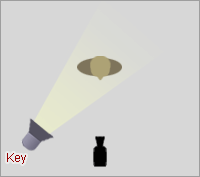
  • Key light- This is the main light point. It is usually the strongest and has the most influence on the look of the scene. It is placed to one side of the camera so that this side is well lit.


Key Light

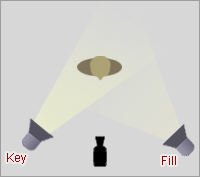
  • Fill light- This is the secondary light point and is placed on the opposite side of the key light. It is used to fill the shadows created by the key. The fill will usually be softer and less bright than the key light.
Key and Fill

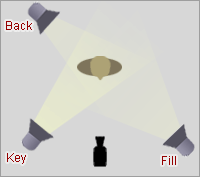
  • Back light- The back light is placed behind the subject and lights it from the rear. Rather than providing direct lighting (like the key and fill), its purpose is to provide definition and subtle highlights around the subject's outlines. This helps separate the subject from the background and provide a three-dimensional look.
Key, Fill and Back


A helpful site i recommend to view this technique; Three point lighting simulator


Advanced Camera Work

Tracking Shot 


Using a Dolly to preform a tracking shot
A dolly is a cart that travels along tube tracks, a camera is mounted to this to record the action and be able to follow it, following the action is called a tracking shot, an easy example of this is feet that are walking. The dolly is set up parallel to the actor with the camera framed up on the actor's feet. The dolly grip pushes the dolly at the same pace of the actor's walking speed for the camera to capture a shot of the feet walking. A camera dolly for your movie can make a world of difference in terms of production value, as a movie is a "motion picture" so it makes sense to add motion, the Dolly and tubes helps for a smooth motion too if you aren't on flat smooth ground. 


Our example of a Tracking Shot:


Using a Dolly to perform an Arc shot
Using this particular type of dolly gives you more freedom with the camera as it can move quickly and at any speed you want it to with a push and basically can go anywhere as long as it is on a flat surface. An arc shot can be used to arc or even circle actors, mainly in dance or action scenes, to help for an easy recording. 


Monday, 21 October 2013

Script Writing: The Rules!

Once you have a story you want to tell and create into movie form, you must write a script.

Industry Presentation Conventions - The Guidelines

Font: Courier       Size:12


There are several rules you must follow while writing a script:  


You must state in the top left hand corner of your script where the scene is taking place INT. for Interior or EXT. for exterior, meaning outside a building. This is followed by the name or setting where the scene is taking place and it must be wrote in CAPITAL LETTERS. 

When doing a characters dialogue, their name should be in CAPITAL print which should be centered on the page, the dialogue of the character should then be wrote underneath their name, also centered.


You can add in the setting the scene information like " a man walks into a bar, wearing a grey tailored suit, sporting stylish sunglasses on top of his head, he sits in a dark booth the far end of bar, out of obvious sight and slips an envelop out his waist coat pocket which he places on the table" This just enables the script reader to get some context and it establish's the scene.  


I currently had some work with script writing and a famous script writing program used is Celtx. Here's an example of how a script should be set out;


Thursday, 10 October 2013

Preliminary Task Review

Recently my group and I completed our first product the Preliminary task, with partners Tilly Whitehouse and Tina Vidmar this is to gain experience of handling software and equipment that we would use later on for our main product.

Our group had to plan, shoot, edit and exhibit a short piece of footage following a criteria that being: filming someone entering a room, sitting opposite another person and sharing two lines of dialogue between them. This has to follow and exhibit the filming rules of 'the rule of thirds', match on action and shot reverse shot and continuity.

What went well? 
The editing and the sequence of clips when put together in the final product making sure it showed perfect continuity through out, I feel it was successful, it went well when shots were matched up.

What is good?
The flow of the video was good and we managed to get all the rules covered that sir asked us to cover. I think our match on action shot was good too 0:06.

Did you follow the production rules? 
The production rules were, not to create continuity errors, to follow the 180 degree rule, to create a good example of match on action, to match cut types and if using sound to match sound where appropriate.
Every one of those rules were adhered to and we made sure to check for any errors after we had finished shooting and editing, the only hard rule to follow was match on action as its the actors job to remember their starting and ending place of the cut, because if they don't we will have continuity when it comes to trying to edit the piece, but with our supervision we managed to over come this.

What went less well? 
We had an actor forget their hand positioning and when editing the clip we discovered this minor continuity error, we had to cut the shot differently so their hands matched up. We also had a numerous amount of repeated scenes where we had to shoot a few times to get the scene right, we had to go through all of them just to find the relevant scenes needed to put on to our storyline.

What did you learn about making films and working within a production team?
You have to communicate a lot between your team and your actors, to be able to get what you need filmed correctly. Being a production team is not a one man job, it has many roles that need to covered and while filming i learned how to perfect match on action. 


Our Preliminary Task Final cut;

Wednesday, 2 October 2013

Match On Action


Match on action is a very simple but essential technique where the perspective of the camera changes during a scene and the scene continues to flow. Mainly used in action and is very quick and almost "jumpy" it shows you more of whats going on in the scene, so as not to miss the action.

An example of Match on Action would be this fight scene from "Never back down":


Cut Types


It is important that I experiment with cut types as sound is the bread and butter to a movie, the right diagetic or non - diagetic sound can really enhance a scene and make it more interesting, for example if you were to do a split edit and have someone screaming in pain before you see splashes of blood or a swing of a knife, the sound will make you jump and change the atmosphere, if you were to just see blood splashing and a knife swinging but there was no sound or even the sound was timed it wouldn't be as climatic as if you had a blank screen and a blood curdling scream and THEN you showed the action.

The reason I am researching into sound cuts is because of this reason, I want to create a good movie with good sound and I must know how i can cut sound and use it first before I can go record it.


Straight Cut

The most basic type of shot transitions, the cut is the most common way to join two shots. It is the most basic in that the film undergoes no special processes to perform a cut; basically the two film strips are simply played one after the other. To watch the movie, this is where one image on screen is instantly replaced with another, often in the form of a camera angle change. This is know as a Straight Cut.

L Cut


An L Cut (Split edit) is an editing technique that results in a cut occurring at a different time for audio than for video. For example, we may hear characters voices a few seconds before we see them on screen. In order to achieve this effect, the editor had to make an L-shaped cut on the filmstrip itself. where the sound will play a few seconds before the video cuts in.

Here's a video example that could help explain better:

180 Degree Rule


The 180 Degree Rule is one of the most if not the most important rules whilst filming. If you do not follow this rule especially when filming a scene between two subjects such as dialogue at a table between the two then the audience watching can become disoriented to which perspective they are viewing the scene from. The 180 degree rule is fairly straightforward. Imagine a line going through the middle of two people having a face to face conversation. Lets say you have a two shot from the side on so you have one person on the left and one on the right. Now from this perspective the camera can be anywhere from the left persons right shoulder to the right persons left shoulder. Any angle between the two is fine however if you are to cross the line down the middle of the two then you have just broken the rule since the audiences perspective has now changed leaving them confused as to who is where, Understand? Watch the video above for a better explanation. 

Rule of Thirds And Continuity


You noticed the closer little boy in dungarees first didn't you, not the cool dead tree ? well there's a reason for that!


Okay! so the theory of "The rule of Thirds" is that if you place points of interest in the intersections or along the lines your frame becomes more balanced and will enable a viewer to "interact with it more naturally." Really, it just means that if you split your frame or picture into 3 horizontal lines and 3 vertical lines, the lines that cross over is where our eyes will be drawn to on a picture, so it makes sense to place the important parts there, right?
It's common mistake to place something in the center of a picture as that's where you would expect the important part to be, but alas our eyes are only drawn to the center of a page if you use a "dead space" technique. 


Continuity


Whilst most continuity errors are subtle, such as changes in the level of drink in a character's glass or the length of a cigarette, others can be more noticeable, such as sudden drastic changes in appearance of a character. Such errors in continuity can ruin the illusion of realism and affect suspension of disbelief.
In cinema, special attention must be paid to continuity because films are rarely shot in the order in which they are presented. Weather, the ambiance of natural light, cast and crew availability, or any number of other circumstances can also influence a shooting schedule this is why in film people are hired specifically to remember positions and such of things to prevent continuity errors.

An example: 


Here's some video footage of some continuity errors in harry potter for a better example of what i'm talking about 


Camera Movement

The perfect video to describe different camera movements and the connotations we can pick up from such moves!


Crab

A less-common term for tracking or trucking. following the action sideways
Dolly


The camera is mounted on a cart which travels along tracks for a very smooth movement. Also known as a tracking shot
Dolly Zoom


A technique in which the camera moves closer or further from the subject while simultaneously adjusting the zoom angle to keep the subject the same size in the frame.
Follow

The camera physically follows the subject at a more or less constant distance.
Pan

Horizontal movement, left and right.
Pedestal 

Moving the camera position vertically with respect to the subject.
TiltVertical movement of the camera angle, i.e. pointing the camera up and down (as opposed to moving the whole camera up and down).


Tuesday, 1 October 2013

Basic Shot Types

There are several different shot types, all have purpose to why they're used they're not just randomly chosen, here are the basics;


Close Ups: Close ups convey the detail and emotion to the viewer. They vary from the real extreme close up to the standard head and shoulders shot.

Extreme close up (ECU) - 
Any shot that zooms in very close to a particular part of a subject is known as an extreme close up. They vary considerably but usually focus on a particular part of a person—the face, mouth, eyes, hands, etc—object, or animal. These shots can create a feeling of intimacy in your video, and to convey a mood or emotion.

Close up (CU) - Close up shots typically contain just the face and shoulders of a subject, with a little head room above
Medium Shots: Medium shots (or mid shots) typically frame subjects from the waist up. These shots help to show people in the context of the background. They are used extensively in film production as they portray the audience’s everyday perception of people.
Medium shot (MS) - The 'waist up' medium shot is ideal when the subject is speaking or delivering information and the fine detail isn't needed. It's also useful when people are gesturing with their arms.

Medium shot (MS) - The 'waist up' medium shot is ideal when the subject is speaking or delivering information and the fine detail isn't needed. It's also useful when people are gesturing with their arms.

Two-shot or three-shot -  The two/three shot is often medium shots, these are shots of two or three people in one scene. They're often used in interviews and are also good for establishing a relationship between subjects.
Long Shots: A long shot shows a great deal of background, be it the set, the landscape or the venue. Long shots are essential to establish the scene for the viewer and to put the rest of the film into context. This is why they are also known as establishing shots.
Extreme long shot (EWS) - Extreme long shots are far removed from the subject and often shot with a wide-angle lens. They may show the subject in the distance, but the emphasis is more on showing the subject in his or her environment.
long shot (WS) - long shots provide an overall view of the whole scene. If the shot contains a person, the whole body is shown.
Creative Shots
Over-the-shoulder shot (OSS) These shots are filmed from just behind a person. They tend to show the back of a person’s head (often cutting off the frame just behind the ear) and sometimes one shoulder.
Point of view shot (POV) - Also called a subjective shot. The camcorder adopts the perspective of a character. We see what a character sees and therefore identify with him/her. The person whose point of view it is should never be seen in the shot

Welcome!

Hey there! I'm Charlotte, I'm currently studying AS Media Studies at Great Wyrley High School and this blog was created to bring you along in my media studies journey. I shall be posting all sorts for my media course, from tasks I am set; to filming, lighting and camera techniques and much more!

This was just a short note to introduce myself and get my blog rolling. Right, so in my next few posts I shall be going over the different effects and techniques when filming like: 


  • Shot Types
  • Camera Movements
  • Cut Types
  • Rule of Thirds
  • Match on action
  • 180 Degree Rule 
  • Continuity
All of these techniques are important for me (or anyone wanting to create a film) to know before they go into producing a movie, you must know the theory before you can experiment after all! So the post's you will see on my blog will all be relevant to the final product and will all play a part in the production process.

Estimated Production work flow

Okay so here's a snap shot of what order myself and some other members of my media group predict the workflow of making our movie to be. It may not be correct some things may come in different orders but this is just an estimation.


Expected Workflow

This is how we expect our work flow to be when we start creating our movie! Its an educated estimation, by myself and media members Deanna and Cameron.